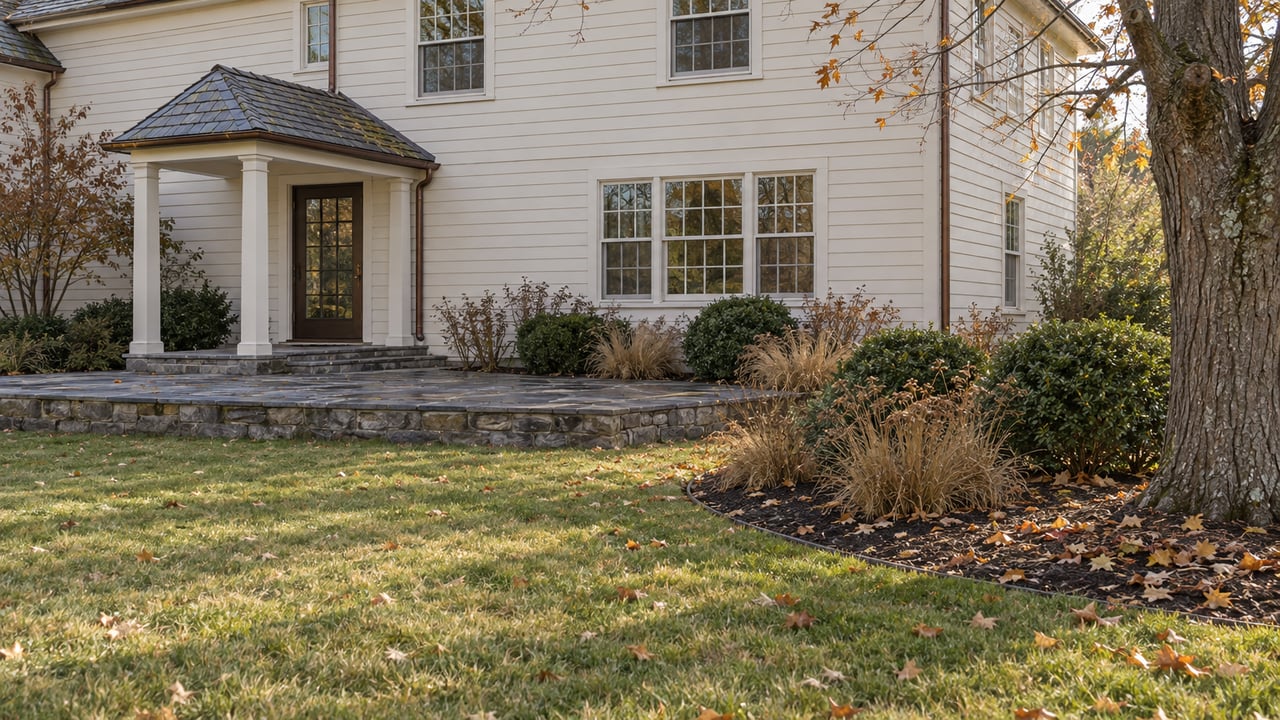
Wyckoff Isn't Planning a Deer Cull. Here's What That Leaves Your Yard With This November.
Last winter a thermal-drone survey counted 432 deer across Wyckoff's 6.65 square miles. That works out to 65 per square mile, above the 59 average for the 12 Northwest Bergen towns in the study. The researchers call that count the low point of the year. Asked this fall whether the Township Committee plans to do anything about it, the township administrator said it does not.
What explains that answer also explains the deer in your hydrangeas. Wyckoff's homes sit close together, and that spacing does two things. It makes a cull hard to carry out, and it puts deer management on each separate property, where the township's fence code tops out below the height the study recommends. In November, the peak of the mating season, that arrangement shows up most clearly on lawns and roads.
The survey was flown at night with infrared-equipped drones by researchers from Raritan Valley Community College's Center for Environmental Studies between Dec. 22, 2025, and April 3, 2026. The report is dated May 17, 2026. According to Wyckoff News, the study started at a Northwest Bergen mayors' meeting in Allendale while Committeeman Rudy Boonstra was Wyckoff's mayor, and a state shared-services grant paid for it at no cost to Wyckoff taxpayers.
Here is how Wyckoff compares with the towns around it:
| Town | Deer counted | Square miles | Deer per square mile |
|---|---|---|---|
| Upper Saddle River | 467 | 5.27 | 89 |
| Oakland | 611 | 8.77 | 70 |
| Allendale | 212 | 3.12 | 68 |
| Midland Park | 106 | 1.58 | 67 |
| Wyckoff | 432 | 6.65 | 65 |
| Franklin Lakes | 613 | 9.88 | 62 |
| Ridgewood | 287 | 5.80 | 49 |
| Glen Rock | 110 | 2.72 | 40 |
| All 12 towns | 4,463 | 76.08 | 59 |
Two details in the report change how to read those numbers. First, the timing. The survey window fell after the fall and winter deaths from hunting, car strikes and cold, and before fawns arrive in May. The researchers estimate that from late May through September, densities run at least 50% to 100% higher than what they counted. So the herd that spent the summer around Wyckoff was likely well above 65 per square mile. The report adds that losses to vehicle collisions and freezing temperatures usually don't become significant until October or later.
Second, the baseline. The report uses about 10 deer per square mile as its benchmark for ecosystem health and public safety. Across the study area, densities averaged 5.9 times that level, and the researchers wrote that "none of the areas surveyed contained deer densities at ecologically sustainable levels." By that measure, Wyckoff in midwinter is running at about six and a half times the benchmark.
That population is now in its most active stretch. In an Oct. 16, 2026 notice, the New Jersey Department of Environmental Protection said peak mating activity usually runs from mid- to late October through mid-December. Bucks chasing does bring more deer onto roads, especially around the morning and evening commutes, when darkness or glare can make them hard to see.
Insurance claims follow the same calendar. State Farm's latest report, covering claims from July 2025 through June 2026, puts a New Jersey driver's odds of an animal-collision claim at 1 in 245, 39th among the states. Nationally, November is the riskiest month, followed by October and December. Deer are the animal hit most often.
Locally, the township's view is that collisions are not the main issue. Township Administrator Matt Cavallo told Wyckoff News that deer-related accidents in Wyckoff are infrequent and placed the frustration somewhere else:
Residents are "understandably frustrated by deer gathering on their lawns and eating their gardens and shrubbery."
Cavallo wrote on Oct. 5 that "the Township Committee is not discussing plans for a deer cull or other deer management measures." His main reason was physical. Homes in many Wyckoff neighborhoods sit closer together than in Franklin Lakes, "sometimes less than 75 to 100 feet apart," which makes it hard to find safe, suitable places for a cull. He also cited state requirements, the need for permission to access private property, and costs that keep coming rather than arriving as a single expense. His conclusion, as reported by Wyckoff News, was that "there is no simple solution in a community where many homes are close together."
The comparison with Franklin Lakes is the point. The survey counted 62 deer per square mile there, a little below Wyckoff, and, as Wyckoff News reported, its Nov. 3 ballot carried an advisory question: "Should the Borough consider conducting a deer cull by bow and arrow annually for three years for the purpose of managing the deer population?" The interpretive statement says the cull would use professional bow hunters, a method approved by the NJDEP. The two towns have similar deer numbers but different lot patterns, and the lot pattern decided which town got the question.
Where hunting isn't possible, the RVCC report's alternative is exclosure fencing "at least 8 feet tall" around native trees and shrubs. Wyckoff's zoning code is written around a lower number. Under §186-29A of the township code, residential fences in side and rear yards "shall not exceed six feet above the normal grade," and the residential section has no exception for deer fencing.
Front yards have tighter limits. The code says front-yard fences can be no more than 50% solid and no more than six inches thick. It bans split rail with chicken wire or mesh, as well as chain link, in front of the house. The Planning Board's application instructions say a front-yard fence over four feet high, or more than 50% solid, needs a variance application. Building, altering or rebuilding a fence in a setback also takes a zoning permit from the Zoning Administrator, with a plot plan and fee. Like-for-like repairs are the exception.
The one township rule aimed squarely at keeping deer out of yards is about food. Wyckoff has banned feeding wildlife since 2005, under Board of Health Ordinance 73. Wyckoff News reported that the Board of Health tightened the ban in 2019 "to discourage coyotes, deer and bears from residential yards." The ordinance text breaks down this way:
The written exemption names one specific setup, a bird feeder with a seed catcher mounted at least six feet up.
With fences capped and the township not acting, a lot of the decision comes down to plant choice. Rutgers NJAES keeps an interactive list of landscape plants rated by deer resistance. It sorts plants into four tiers, from "Rarely Damaged" to "Frequently Severely Damaged." American holly and arrowwood viburnum are in the top tier. The same tension turns up in township land-use files. One landscaping plan presented to the Board of Adjustment this year specified rhododendrons because they are "more deer-resistant."
For a look at native plantings and wildlife closer to home, Bergen County's James A. McFaul Environmental Center at 150 Crescent Avenue is a wildlife sanctuary with trails, gardens and science exhibits. The park is open 8 a.m. to 5:15 p.m. on weekdays and 8:30 a.m. to 5:15 p.m. on weekends and holidays, and it closes on Thanksgiving, Christmas and New Year's Day.
The researchers recommend repeat surveys every three to five years. They would pair each count with harvest data, collision data and forest plots, so towns can tell whether management is working. Until then, Wyckoff's deer management happens one lot at a time, under a six-foot fence limit, a feeder rule, and whatever gets planted along the property line.
This post is general information, not legal advice. Before you put up a fence or change a feeder setup, check the specifics with the township's Zoning Administrator or the right professional.
Keeping a yard in good shape when deer come through every night is a real part of owning a home in Wyckoff, and it affects how a property looks on the day it goes to market. If you're wondering how your landscaping and curb appeal factor into your home's value, Keren Abraham can walk the property with you. Let's make it happen. Get your free home valuation.

As a trusted advisor, I am dedicated to serving my community, clients, and friends. My ultimate goal is to provide a 1st class, white-glove experience, ensuring a smooth and seamless move. With my extensive experience as a businesswoman, I am committed to guiding you towards making the right investment decisions.